
CARETRACE
Personal baselines from Apple Health and wearables for sleep, recovery, heart, and activity — with signal confidence and optional family sharing.



Physiological signal processing · EEG · BCI · Adaptive AI
Advanced Engineering Lab develops physiological signal-processing and adaptive AI systems from wearable, neural, sleep, heart, activity, and recovery data — with uncertainty treated as part of the measurement.
Wearables and neural sensors only observe fragments of the body. AEL builds systems that determine what those signals can reliably support, quantify confidence, and then use AI to explain the result.
Approach
Biological sensors provide noisy, incomplete observations. AEL computes an inspectable estimate, evaluates the quality of the evidence, attaches confidence, and only then uses language models to explain the result.
The model describes the estimate. It does not make it.
Signal
Incomplete biological observations.
Estimate
Deterministic, inspectable computation.
Confidence
Evidence quality made explicit.
Interpretation
Language explains what was measured.
AEL systems track which signals contributed to an estimate, how reliable they were, where signals disagreed, and what the available data cannot support.
Confidence is engineered into every output. Signal quality, missing data, degraded inputs, and disagreement determine the bounds of inference.
Which signals contributed, and how reliable were they?
How far does this reading sit from the person's own baseline?
Did sensors agree, or did the evidence conflict?
What does the available data not support?
Across days
CareTrace studies physiological change over time using heart, sleep, activity, recovery, and wearable data.
Across seconds
OMLAB studies neural and physiological state using EEG, HRV, voice, and multimodal signals.
Both ask the same question: how much can a system reliably infer from incomplete biological signals?

Neural and physiological research platform for short-timescale state from EEG, HRV, voice, and multimodal sensor streams.
Current focus
Understand your health patterns. Stay connected to the people you care about.
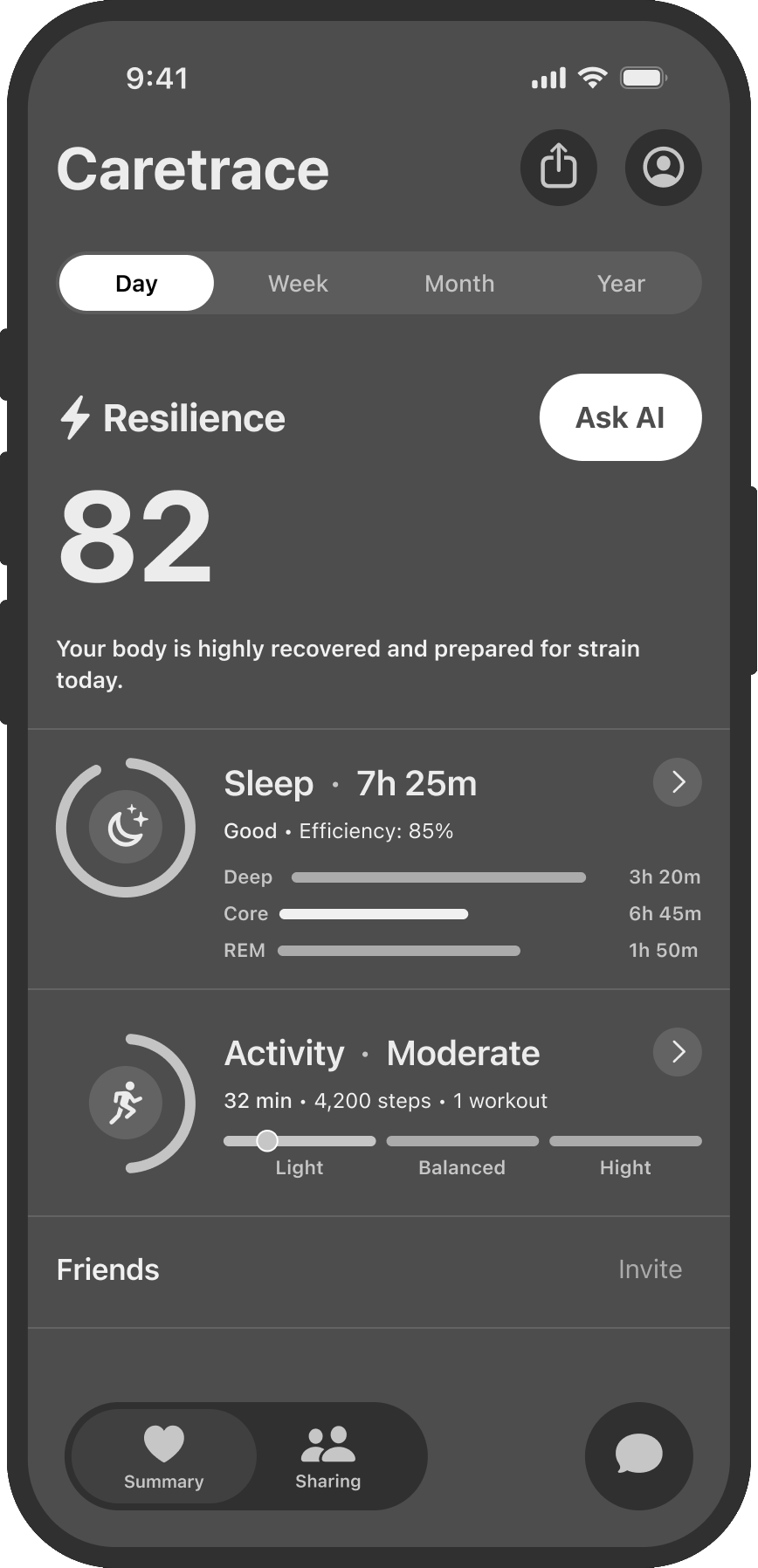
CareTrace turns Apple Health and wearable data into a personal baseline for sleep, recovery, heart, and activity. It helps people see what changed, how much evidence supports the estimate, and optionally share their health picture with family.
See change against your own baseline rather than only a population average.
Review readiness and long-term patterns with estimate confidence visible.
Connect sleep, recovery, heart, and activity in one health picture.
Share with family by choice; each person's baseline remains separate.
Research
Extracting usable information from noisy biological sensor streams.
Understanding change relative to the individual rather than only population averages.
Making confidence, sensor quality, disagreement, and missing data part of the output.
Combining signals only when the combined evidence justifies stronger inference.
Studying measurable relationships between neural signals, physiology, and state.
Using language models to communicate computed findings rather than manufacture them.
AEL defines each claim by the resolution and reliability of its source data.
AEL systems are not substitutes for medical diagnosis.
Consumer wearable signals are not equivalent to clinical measurements.
EEG research does not imply thought decoding.
Confidence depends on the available evidence and sensor quality.
Language models do not generate the underlying physiological estimate.
We state what the signal can support — and stop there.
Collaboration
We collaborate with research groups and technology teams working on wearable sensing, neuroscience, physiological AI, signal processing, and human-computer interfaces.
Open to universities, neuroscience labs, wearable and health-technology companies, AI research organizations, sensor manufacturers, and strategic R&D partners.
Contact the labThat is the research question behind CareTrace and OMLAB: build from observable signals, make the evidence inspectable, and keep every interpretation within what the measurement can support.
Neural and physiological research platform for short-timescale state from EEG, HRV, voice, and multimodal sensor streams.